Series VIII: Performing Arts • Vol. 14 (63) Special Issue https://doi.org/10.31926/but.pa.2021.14.63.3.17
Claudia-Ligia ŞUTEU1
Abstract: This article aims to conduct a study on the skills of the collaborative pianist. His role changed during centuries in terms of requirements and deep understanding of the repertoire. He became equal to the soloist, especially after 1770, with the arrival of the fortepiano. The keyboard’s importance has increased in the Classical period. Aspects of technique and interpretation highlighted the capacity of a performer. This study refers to the accompanist as a complex figure, with functional pianistic skills, being able to differentiate types of accompaniments, the attributes of different musical eras and sight- reading capabilities. The analysis plays a critical role in the development of the collaborative pianist. For guiding the musical interpretation of a piece, aspects regarding style, musical form and character of the chosen repertoire lead to a deep analysis and continuous learning in the accompanist career. Excellence in performance, especially when it comes to an ensemble, can be obtained through a list of steps, starting with solving the technical problems, analyzing and understanding the meaning of music, and the collaborative pianist being the complete musician.
1. Introduction
The piano performance has been analyzed for a long time, but this article studies the aspects of the pianist as accompanist, who is in close contact with the soloist, as they should be treated as equals.
Historically speaking, the role of the accompanist started in the 17th century, where it is mentioned the basso continuo player and developed towards the contemporary ensembles. The most challenging aspect of the accompanist career is to see beyond the score, to make coherent sense of the repertoire.
The term “collaborative pianist”, as it is often mentioned in the existing literature, was used by Kurt Adler after 1950 (Adler 1965, 107).
Expectations of a collaborative pianist refer to deeply understanding the music, not only the piano part but also the instrumental part or the vocal one. His career is based not only on practice but also on analysis. The ensemble collaboration requires the unfolding of music through strategies that incorporate profound analysis of music.
The accompanist has to be perfectly synchronized with his partner. One of the most discussed aspects is the active listening, a skill that has to be continuously improved by the performer.
Norman Doidge defines the term “collaboration” as a mix that requires a high level of trust, space-sharing, and devotion (Doige 2007, 35). Moreover, the article underlines the social transformations that will need to take place for a piano soloist to become a collaborative pianist and the historical background that encouraged the development of this field.
2. Discussion
2.1 Historical context of collaborative piano playing
The historical background to accompaniment has been studied for decades. Significant literature presents the books of Gerald Moore, spanning over forty years. He published his first book in 1943, and it is called “The Unashamed Accompanist”.
From the early 1600s, the accompanist had to play harmonies from the figured bass. His skills developed as he had to improvise counterpoint. Johann Sebastian Bach was one of the most important composers in terms of increasing the accompanied keyboard music. A main role had his sonatas for obbligato keyboard and violin or flute.
The clavichord and harpsichord have been replaced with the pianoforte, which totally transformed the role of the piano player. The invention of the pedal was crucial in terms of interpretation and freedom of the piano performance. The Classical era was based on virtuosity and many composers played accompaniments in their own compositions.
In Beethoven’s duo sonatas for piano and violin, there is a relation based on equality. Beethoven composed the piano parts that he played by himself, showing his virtuosic capabilities.
The accompanist’s role increased again in the Romantic period, where songs of composers such as Franz Schubert, Robert Schumann and Johannes Brahms wrote song accompaniments of an amazing beauty and deep expression. The collaborative pianist is transformed into a source of profound color to generate emotion. The German Lieder refers to the piano accompaniment as much more than rhythmic and harmonic assistance.
Phillip Cranmer wrote a very important book in 1970, called “The Techniques of Accompaniment”, in which he describes the “attitude of mind”. He claims that “Most of us accompanists are too retiring and self-effacing, and these
characteristics show themselves in modest and obsequious playing. The greater part of our work, however, both with singers and instrumentalists, requires us to be equal partners” (Cranmer 1970, 8).
2.2. Aspects of technicality in the piano performance
The accompanist is a complex musician. There is a need of flexibility and ease of understanding the particularities of each instrument or voice. “If you can’t sing it, you can’t play it!” (Katz 2009, 7) means that the collaborative pianist has to be able to sing properly to deeply understand the repertoire.
A first argument refers to the printed dynamic mark, which will be perceived differently by the pianist if he plays in the same register as a string instrument. Nielsen Price claims that using rich pedaling perfectly sustains the vibrato of violinists (Price 2005, 47). Another argument is based on the fact that the accompanist changes his performance when it comes to wind instruments. After an accurate analysis of the flute part, for instance, the pianist has to consider register and timbre. The bottom register of the flute does not allow playing sounds with intensity. The accompanist has to adjust the level of his part, resulting a soft piano playing.
Another aspect of technicality in the ensemble performance is that the collaborative pianist has to breathe together with a singer to be perfectly synchronized. On the other hand, it is an accessible way to unfold the needs of his partner, such as the lack of air on particular phrases. The pianist will easily go beyond the score, rushing that phrase, being sensitive to breathing. Martin Katz, whose accompanist career is well known, claimed that “I have never stepped onto a stage or even into a rehearsal without being able to sing the soloist’s music and play my own part simultaneously” (Katz 2009, 8). In order to be able to anticipate the singer’s intention, one collaborative pianist has to be a great theorist, embellished with flexibility and respect for the talent of his partner.
The term duo has a meaningful significance for the collaborative pianist. When it comes to the technical aspects of an accurate interpretation, style is crucial. Whether the pianist accompanies an instrument or a singer, the background of a powerful performance is given by the accuracy of style. Jane Bathori claims that “It is perhaps style that singers lack the most – however, it is an indispensable element to sing well…One must first have the discipline to respect the musical text. This is the first step to take, to penetrate the meaning of the words, because they all have extreme importance. Musicality can and must help interpretation, but it does not suffice: taste is also necessary” (Bathori 1986, 3). The collaborative pianist can increase the value of a performance by perfectly integrating the character of a certain musical period, resulting in style in performance.
One very important aspect that enhances the piano performance is the sight-reading. The experience of an accompanist is given by the speed with which the pianist illustrates the style, recognizes rhythmic patterns or repeated ones. Technical abilities must be practiced constantly in order to easily play blocked chords, arpeggios and scales, without reading every single note, but to functionally understand music. There are many aspects when it comes to technicality of music performance and the collaborative pianist has to be the complete musician.
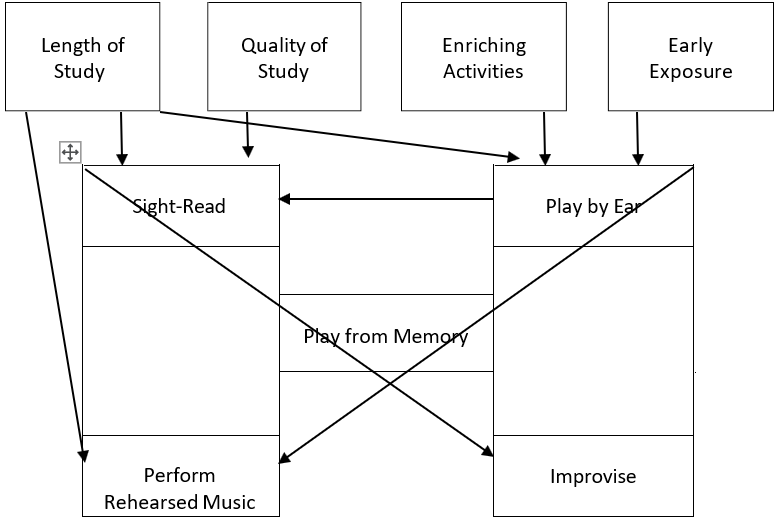
The model (Figure1) indicates various music performance capabilities (McPherson, 1997, 107). Sight-reading, playing by ear, playing from memory, improvising and performing rehearsed music depend on the main four variables, such as the length and quality of study, enriching activities and early exposure. There is strong interdependence between all the factors presented above.
3. Performance consideration and body language
The ensemble’s excellence requires more than an accurate performance of the repertoire. There is a bond that has many layers, the performance being a
collaborative effort. The perfect picture of the performers on stage refers only to the foreground of the whole image.
The grammatical structure of collaborative speech starts with the tone of the voice and not with the words. Body language is crucial when it comes to dialogue in a musical ensemble. It can enhance a performance or it can ruin it by sending inaccurate signals. There is a subconscious area, this is the main reason that the collaborative pianist has to understand these behaviors that are often problematic and physical barriers in rehearsal and performance.
The advantage of a piano performer is that he does not have to hold the instrument, having large freedom in using the arms. These send various powerful signals. In a rehearsal, for instance, the accompanist has to pay attention to the way he uses his arms, avoiding the cross-armed position. This can negatively affect the entire dialogue, possibly the performance. An interesting fact about the feet of the pianist is that the accompanist is locked in the position of using the pedals. When the music stops he should change the playing position, otherwise the partner could understand disinterest while verbally communicating. The pianist should consider two different positions – one for playing and another one for talking with the performer. Eyes are crucial when it comes to performance. The partner has to constantly enhance his peripheral vision, while the pianist will not look toward the keyboard anymore. The feeling of the distance is accurate and practiced many years, this being a result of reflexes gained over time. Eyes communicate with the partner and encompass the musical score, especially when it comes to sight-reading rehearsals.
The pianist has to be ready for various situations, for anything to occur in recitals. He should be capable to conform accordingly, as the pianist is the only musician who keeps the full score in front of them. “The accompanist must be intimate with the geography of a song. He must have an eye for the country, not only knowing in advance all the scenery and beauty spots to be pointed out, he must be aware of the sharp bends that lie ahead of him and the concealed turnings and built-up areas” (Moore 1959, 73).
There are many aspects that are considered when it comes to the ideal relationship between the collaborative pianist and his partner and there has to be a balanced activity concerning the complete musician. A certain routine is necessary, varying from the rehearsals to the final performance.
4. Conclusions
This study has focused on the accompanists but the results demonstrate that analysis is essential in the learning, rehearsing and aiming for excellence in performance. Even though there are many changes due to the evolution of music, the analytical function of the collaborative pianist has been a constant. There are also many challenges, such as sight-reading, which is a demanding skill that requires continuous exercise.
The art of being a collaborative pianist represents a reservoir of knowledge, an infinite effort to go beyond the notes and anticipate the intentions of the partner. The pianist has to pay attention to all the melodic exchanges that may appear between the solo and accompaniment parts. Interpretation considerations are revealed by unfolding the layers of the score, from difficult passages to harmony and expression (King 2017, 25). The body language and the dialog are essential when it comes to building a strong bond with the partner.
Gerald Moore wrote in his book that “The ensemble pianist or the accompanist or the man ‘at the piano’ – to be first-rate at his job does not need to be a superman. He does need to be a good pianist, he does need sensitive ears, and he does need a sensitive musical brain. Strangely enough, too, he does need in his chemical makeup, that repository of all human feeling, that source of poetry, fire, and romance, namely, a heart” (Moore 1962, 101).
Regarding the components of musical excellence in the career of a collaborative pianist, physical coordination and musical expression serve as the resources for the immediate result, while musicality and cultural exposure represent the main aspects that scaffold the final performance.
References
Adler, Kurt. 1965. The Art of Accompanying and Coaching. Mineapolis: University of Minnesota Press.
Bathori, J. 1986. Style. Typewritten article in the Bathori archives. Paris, France: Bibliotheque Nationale.
Cranmer, Philip. 1970. The Technique of Accompaniment. London: Dennis Dobson.
Doidge, Norman. 2007. The Brain That Changes Itself: Stories of Personal Triumph from the Frontiers of Brain Science. New York: Penguin Books.
Katz, Martin. 2009. The Complete Collaborator: The Pianist as Partner. New York: Oxford University Press.
King, Elaine and Evgenia Roussiu. 2017. “The Empathetic Nature of the Piano Accompanist.” Music and Empathy. Abingdon: Routledge.
McPherson, Gary E., Michael Bailey, Kenneth E. Sinclair. 1997. “Path analysis of a theoretical model to describe the relationship among five types of musical performance”. Journal of Research in Music Education 45(1): 103-129.
Moore, Gerald. 1959. The Unashamed Accompanist. Strand, UK: Methuen & Co. Moore, Gerald. 1962. Am I Too Loud? Memoirs of an accompanist. Middlesex:
Penguin Books.
Priece, Nelson Deon. 2005. Accompanying Skills for Pianists. Culver City, California: Culver Crest Publications.
Notes
- Transilvania University of Braşov, claudiasuteu@yahoo.com ↩︎
